



Unpack SMCO’s 3Q 2026 commentary on the AI-related selloff, portfolio adjustments, and the outlook for small- and mid-cap stocks.
HCM Insights
The second quarter of 2026 marked what appears to be a sharp reversal from the more fragile and defensive environment that defined the first quarter. What began as a period of elevated geopolitical risk, sticky inflation, and caution around capital-intensive growth themes evolved into a broader risk rally as equity breadth improved and investors again rewarded companies tied to AI infrastructure, semiconductors, power, industrial capex, and global reflation.
Against this backdrop, the Hilton Dividend & Yield Strategy ("DIVYS") generated a strong absolute and relative return. The DIVYS composite generated a preliminary return of +10.13% gross / +9.98% net during the quarter, compared to the +9.05% return for the Nasdaq US Broad Dividend Achievers (“benchmark”), resulting in outperformance of roughly 108 basis points. This quarter's result recaptured a meaningful portion of the first-quarter relative shortfall, bringing year-to-date preliminary performance to approximately +8.04% gross /+7.76% net versus +8.79% for the benchmark, or roughly 75 basis points of underperformance through the first half of 2026.
We view the quarter as an important validation of the strategy's balanced philosophy. DIVYS is not constructed as a traditional high-yield or low-volatility dividend portfolio. It is designed to balance income, dividend growth, and capital appreciation, which means the strategy will often own free-cash-flow-rich growth companies that are dividend eligible, but may not resemble the highest-yielding areas of the dividend universe. In 2Q26, we saw that orientation help materially as the market rewarded dividend compounders with exposure to secular growth themes and improving cyclical momentum.
The quarter also reinforced the dividend-growth component of the strategy. As of quarter-end, DIVYS' trailing twelve-month dividend growth rate was approximately 23.6%, well above the Nasdaq US Broad Dividend Achievers benchmark and the S&P 500 Dividend Aristocrats. This was driven primarily by holdings with meaningful dividend increases, underscoring that the strategy is not simply seeking static yield, but instead trying to own companies that can compound income over time through durable free cash flow growth.
At the same time, we remained disciplined around valuation, sector risk, and portfolio volatility. The quarter included meaningful participation in the market rally, but also a clear shift later in the period toward harvesting gains, trimming extended AI-linked exposures, and reallocating toward companies with more balanced risk/reward profiles.
Second Quarter Performance: Selection Strength Offset by Allocation Drag
Relative performance in the second quarter was driven primarily by security selection. Security selection contributed approximately 292 basis points to relative results, while asset allocation detracted approximately 170 basis points and FX allocation detracted approximately 1 basis point. In other words, the strategy was rewarded for the specific companies it owned, even as cash, and structural sector differences versus the Nasdaq US Broad Dividend Achievers benchmark created an allocation drag in a sharply rising market.
Information Technology was the largest positive contributor to relative performance, adding approximately 195 basis points. The strategy benefited from strong results across several dividend-eligible AI and semiconductor-related holdings, including Applied Materials, Taiwan Semiconductor, Microsoft, Cisco, Qualcomm, and Analog Devices. This reinforced our view that a dividend strategy can participate meaningfully in secular growth when it focuses on businesses with strong free cash flow, shareholder return, and durable competitive positioning.
Consumer Staples also contributed positively, adding approximately 62 basis points, despite the portfolio remaining underweight the sector relative to the benchmark. This was driven by favorable selection within our owned exposures, including Philip Morris and British American Tobacco, rather than a wholesale shift towards larger benchmark weights such as Walmart or Coca-Cola. Consumer Discretionary and Industrials also added modestly, helped by selective exposure to companies tied to market breadth, industrial automation, and capital spending.
The primary sector-level headwinds came from Materials, Financials, Health Care, and Communication Services. Materials detracted approximately 47 basis points, with Dow weighing on results after our initial purchase as the market remained skeptical that improving polyethylene spreads would prove durable. Financials detracted roughly 42 basis points, largely reflecting the portfolio's underweight to the sector despite positive contributions from select holdings such as Franklin Resources, Citigroup, UBS, Bank of America, and BlackRock. Health Care detracted approximately 33 basis points as the portfolio remained underweight defensive healthcare exposure, while Communication Services detracted approximately 26 basis points as AT&T and selected ETF exposure lagged.
At the security-selection level, the largest positive contributors included Applied Materials, XLC, Taiwan Semiconductor, Microsoft, Cisco, Qualcomm, Franklin Resources, Philip Morris, Siemens AG, and Williams Co. The largest detractors included Motorola Solutions, Dow, TE Connectivity, IBM, NVIDIA, Eli Lilly, AT&T, Xylem, SAP, and AstraZeneca. Several of these detractors were position-timing or relative-weight effects rather than thesis breaks, and in multiple cases we used the quarter to refine exposure and improve the portfolio's forward risk/reward.
Benchmark and Sector Framework: Important Context for Allocation Effects
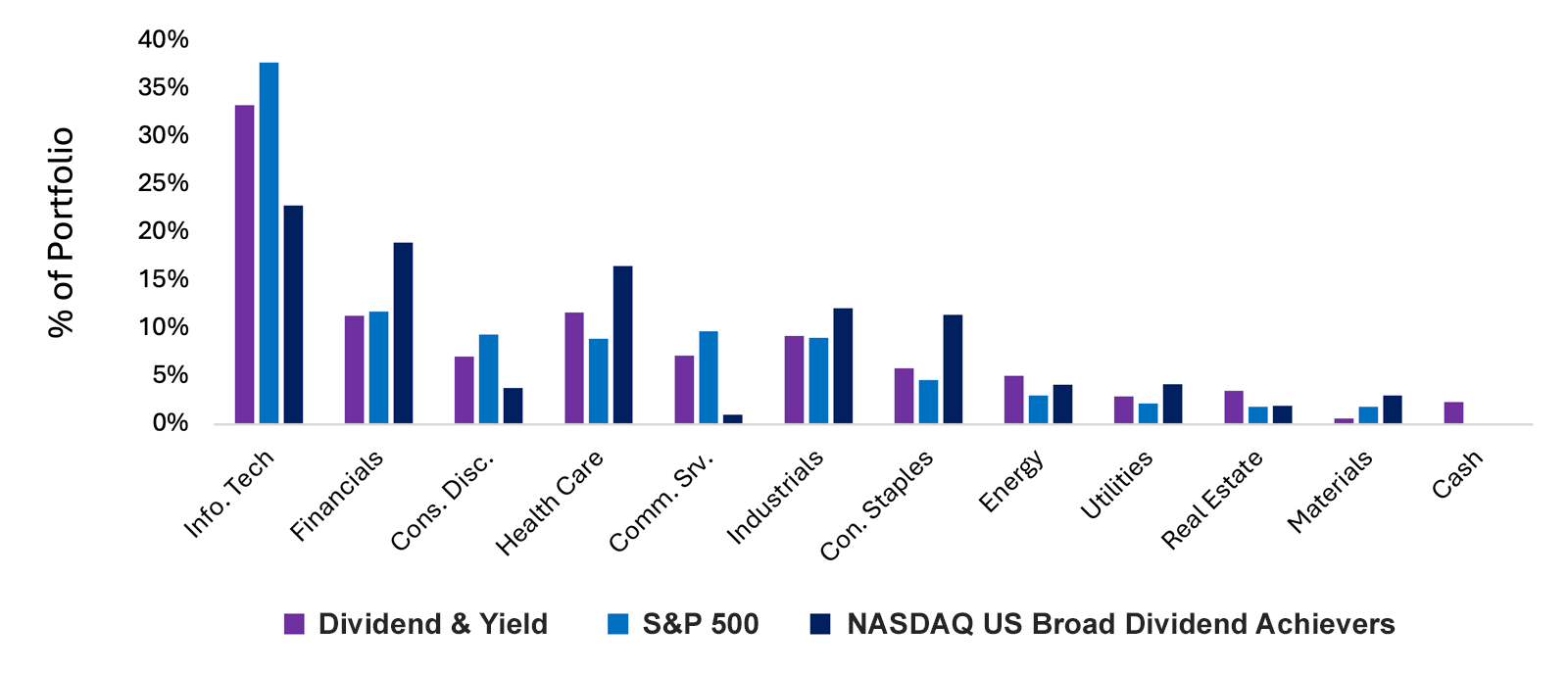
The allocation result deserves context because DIVYS is managed with sector guardrails tied to the S&P 500, not to the Nasdaq US Broad Dividend Achievers benchmark's sector composition. In most sectors, the portfolio must remain within +/-3 percentage points of the S&P 500 sector weight, with a wider +/-5 percentage point band for Information Technology given its size in the market. This structure is intentional: it prevents the strategy from becoming an unconstrained sector bet while preserving room for active stock selection and dividend-growth exposure.
Figure 1: Dividend & Yield Sector Weights v. S&P 500 v. Benchmark*
*Benchmark: NASDAQ US Broad Dividend Achievers
×
![Bar chart comparing sector allocations for three investment portfolios: Dividend & Yield (purple), S&P 500 (blue), and NASDAQ US Broad Dividend Achievers (dark blue). Information Technology is the largest sector in all three, at approximately 33%, 38%, and 23% respectively. The NASDAQ US Broad Dividend Achievers index has higher allocations to Financials, Health Care, Consumer Staples, and Industrials than the other two. The S&P 500 has the highest allocation to Information Technology and Communication Services, while the Dividend & Yield portfolio maintains small allocations across Energy, Utilities, Real Estate, Materials, and Cash. The y-axis shows percentage allocations from 0% to 40%.]()
Figure 1: Dividend & Yield Sector Weights v. S&P 500 v. Benchmark*
Source: Bloomberg, as of 6/30/26
That framework creates a natural constraint when the benchmark is itself meaningfully over- or underweight sectors relative to the S&P 500. With that in mind, DIVYS was approximately 10.5% overweight Information Technology, 7.6% underweight Financials, 5.6% underweight Consumer Staples, 4.9% underweight Health Care, and 6.2% overweight Communication Services relative to the NASDAQ US Broad Dividend Achievers. In our view, this helps explain why asset allocation detracted despite strong absolute and relative performance. Some of the allocation effect reflects structural benchmark differences that cannot be fully neutralized without violating the strategy's S&P 500-based sector discipline.
Strategy Activity: Re-Risking, Refinement, and Volatility Control
The trades listed herein encompass all transactions executed under the strategy during the second quarter (April 1 – June 30). This update is intended to offer a complete and transparent reflection of trading activity for second quarter of 2026.
Strategy activity during the quarter reflected a progression in our thinking as the market backdrop evolved. We began the quarter by broadening exposure beyond the most defensive areas of the benchmark, moved through the middle of the quarter by adding yield-eligible AI and cyclical growth exposure, and ended the quarter with greater emphasis on valuation discipline, risk control, and diversification away from the most extended AI beneficiaries.
April: Broadening Exposure as Risk Appetite Improved
We began the quarter by trimming the State Street Communications Services Select Sector ETF (XLC) and initiating a position in AT&T. The XLC trim reduced exposure to more mega-cap and hyperscaler-linked Communication Services exposure after a strong period of performance. AT&T provided a more value-oriented, income-generating way to maintain sector exposure, supported by improving wireless fundamentals, continued fiber growth, improving free cash flow, and a clearer balance sheet deleveraging path. We later added modestly to AT&T after earnings, as the quarter supported the thesis that churn and near-term free-cash-flow noise were masking improving underlying trends in fiber, fixed wireless, and convergence.
We initiated Dow as a cyclical value opportunity coming off a deeply depressed 2025 earnings base. The position was built around the view that tighter polyethylene supply, Middle East disruptions, Dow's ethane-advantaged North American system, and self-help actions could support a meaningful EBITDA and earnings recovery from trough levels. We recognized that the key risk was whether the improvement would prove to be a temporary margin snapback rather than the beginning of a durable cycle turn, but believed expectations had become sufficiently depressed to create an attractive asymmetric setup.
We added back to TE Connectivity (TEL) after a valuation reset and then increased the position again later in the month. TEL remained attractive to us because it combines exposure to AI-related connectivity, copper, and connector content with a broader cyclical recovery across transportation, industrial, and other traditional end markets. The shares had pulled back after a meaningful earlier run, and we believed the valuation again better reflected the company's long-term growth opportunity.
We trimmed Williams after strong performance, as the stock's valuation had become more demanding and geopolitical risk premia appeared vulnerable to reversal if Iran-related disruptions eased. Williams remains a high-quality cash-flow compounder, but the multiple left less margin of safety. We redeployed a portion of the capital into Qualcomm, which we viewed as a differentiated beneficiary of AI shifting toward edge devices, on-device compute, mobile, PC, and connectivity applications. The stock traded at a material discount to many AI beneficiaries, giving the strategy a lower-multiple way to participate in the next phase of AI adoption.
Within Financials, we exited Wells Fargo and initiated positions in Citigroup and UBS. The Wells Fargo exit reflected concerns that net interest income expansion and core profitability were lagging peers, leaving the stock more exposed to spread compression without a clear offset from fee growth. Citigroup offered improving revenue breadth, restructuring progress, excess capital, and a credible path toward higher ROTCE and multiple expansion from discounted levels. UBS added exposure to wealth management, capital markets recovery, integration synergies, capital return, and potential regulatory relief in Europe.
We also initiated NVIDIA and added to the position during April. NVIDIA became more attractive within the DIVYS framework as its capital return profile improved and the AI infrastructure cycle continued to broaden and extend. We viewed the company's valuation as increasingly reasonable relative to its exceptional forward revenue and EPS growth, with hyperscaler demand, financing capacity for AI buildouts, and potential AI ecosystem liquidity events all supporting demand durability.
We used Health Care strength to manage sector exposure and remain within the strategy's sector guardrails. AstraZeneca was trimmed initially due to sector-band discipline and later reduced again alongside trims to Quest Diagnostics and AbbVie. These were not thesis changes. We continued to view these companies as durable healthcare compounders, but healthcare had become a source of capital to fund areas with more immediate upside as the macro environment became more supportive for cyclicals, energy, and AI infrastructure.
We exited IBM due to valuation and growth concerns. The stock had re-rated while software growth disappointed, and we saw increasing risk that AI could disrupt portions of the company's legacy consulting and services businesses. Proceeds were reallocated toward NVIDIA, where the linkage to AI capex and earnings growth was more direct.
We increased Chevron and ExxonMobil as geopolitical disruptions in the Middle East raised perceived supply risk and supported a more constructive oil-price backdrop. We viewed both companies as high-quality, cash-generative energy exposures with reasonable valuations and strong shareholder return profiles, while U.S. production and LNG exposure provided strategic advantages in a tighter global supply environment.
Finally, we exited Teradyne after a very strong move in the stock and trimmed Qualcomm after a sharp rally. In Teradyne, the stock had more than 1.5x'd from our initial investment and the multiple had expanded meaningfully ahead of earnings, creating a less favorable near-term risk/reward. In Qualcomm, the original AI edge thesis was beginning to be recognized by the market, but management execution risk and the speed of the move warranted harvesting gains and reducing volatility. We redeployed a portion of the capital into NVIDIA, where conviction in the AI infrastructure cycle had strengthened.
May: Maintaining Sector Discipline and Adding Yield-Eligible AI Exposure
May activity focused on maintaining sector discipline while increasing exposure to areas where AI infrastructure, enterprise software, and power bottlenecks were becoming more visible. Because the strategy is managed against S&P 500 sector guardrails, we used Fidelity MSCI Consumer Discretionary ETF (FDIS) and XLC adjustments to keep Consumer Discretionary and Communication Services exposure aligned with the framework. These were primarily portfolio-construction and risk-control trades rather than major changes in our underlying view on either sector.
We initiated Microchip as a starter position and later increased it to a full 1% position. The thesis was that the AI infrastructure buildout was broadening into analog, power, embedded control, and voltage-management semiconductors that had not yet been fully repriced as AI beneficiaries. While Microchip still faces cyclical headwinds from autos, EVs, and industrial end markets, we believed the emerging data-center power and control opportunity created an attractive asymmetric setup if AI-driven demand began to overwhelm legacy weakness.
We trimmed Qualcomm again after the stock had rallied nearly 70% from its April lows. Although the valuation remained reasonable, we became more cautious that investors were increasingly capitalizing a successful AI edge and data-center execution path despite the company's mixed history in new growth initiatives outside handsets. The trims were intended to lock in gains and keep the position appropriately sized.
We increased Oracle to 2.0% as the company remained one of the clearest dividend-eligible ways to gain exposure to the AI infrastructure buildout. Oracle's OCI demand, multi-cloud database services, and AI training and inference workloads were improving, while the large RPO backlog created a path to meaningful revenue and earnings growth if capex and funding concerns were managed. We viewed the stock as attractive on a forward growth-adjusted basis, while recognizing leverage, capex intensity, and execution as key risks.
We initiated SAP, funded by a reduction in utilities exposure through State Street Utilities Sector ETF (XLU) and cash. SAP offered a yield-eligible way to participate in the enterprise AI transition while adding a more idiosyncratic return driver than regulated utilities. In our view, SAP's ownership of core enterprise data, workflows, permissions, compliance infrastructure, and system-of-record processes should become more valuable in an agentic AI world. The company's cloud transformation, AI monetization optionality, margin expansion, net cash balance sheet, and depressed software sentiment created an attractive risk/reward for a starter position.
June: Harvesting Gains and Improving Balance
June represented a shift from adding risk to refining risk. Market performance had become very strong, particularly across AI infrastructure and semiconductor-linked names, while the rate backdrop became less benign as policy risk moved in a more hawkish direction. We therefore focused on harvesting gains, reducing volatility, and adding exposures with more idiosyncratic drivers.
We exited Xylem and initiated Flowserve. Xylem remains a high-quality water infrastructure platform, but the investment case had become more dependent on delayed organic growth reacceleration and continued margin execution. Flowserve offered a more attractive combination of valuation, self-help, aftermarket growth, energy security, power, nuclear, water infrastructure, and margin improvement. We also viewed Starboard's involvement as a potential catalyst for simplification, footprint rationalization, pricing, and capital return.
We trimmed Analog Devices, Cisco, and Taiwan Semiconductor after strong performance. These were not thesis changes. Analog Devices remains well positioned for industrial, automotive, and edge-AI recovery; Cisco remains a durable cash-flow compounder with growing relevance in AI networking; and Taiwan Semiconductor remains one of the most important structural winners in advanced-node manufacturing and accelerator demand. However, the positions had appreciated meaningfully and had become more sensitive to higher rates, valuation compression, and AI-expectation risk. The trims helped preserve gains while maintaining core exposure.
We initiated Welltower as a diversifying REIT exposure with strong company-specific earnings momentum that is not directly tied to the AI or semiconductor cycle. Senior housing demand remained robust, SHOP same-store NOI growth was strong, occupancy recovery continued, pricing power remained healthy, and operating leverage created the potential for further guidance upside. While valuation is demanding, we believed Welltower's balance sheet, liquidity, and senior housing consolidation opportunity supported initiating a position.
At quarter-end, we trimmed Qualcomm further and increased Microsoft. Qualcomm had become more volatile as the market increasingly capitalized management's longer-term data-center and GPU ambitions, despite elevated execution risk and reports of engineering departures. Microsoft offered a more balanced risk/reward within Technology. The stock's relative valuation appeared historically attractive, the business mix is more defensive, and the company remains one of the best-positioned incumbents to monetize AI through enterprise distribution, cloud scale, software integration, and strategic exposure to leading frontier AI platforms.
2Q Attribution Snapshot
All performance is preliminary and unaudited.
- Quarter end allocation to cash was down at 2.31% (from 6.41% in 1Q26) due to recent purchases.
- Yield on the Portfolio as of 06/30/26 was 1.97% and the 1-year beta was 0.75
- The Dividend and Yield Strategy returned +10.13% (+9.98% Net) for 2Q26, which was ahead of the benchmark by 108 basis points.
- Relative to the Nasdaq US Broad Dividend Achievers (DAATR), DIVYs was overweight Information Technology, Consumer Discretionary, Communication Services, Real Estate, and Energy.
- For 2Q26, top ten contributors included AMAT (+186bp), TSM (+140bp), CSCO (+81bp), ADI (+59bp), QCOM (+48bp), SIEGY (+44bp), BEN (+38bp), FANUY (+30bp), FDIS (+26bp), PM (+17bp)
- For 2Q26, top ten detractors included LLY (-66bp), SAP (-34bp), DOW (-34bp), T (-26bp), XLC (-16bp), V (-16bp), CVX (-16bp), FLS (-9bp), ABBV (-8bp), MCD (-8bp)
- The DIVYs Strategy continues to maintain a low standard deviation versus the market one year standard deviation of 10.1% vs. benchmark* of 8.6% and the S&P 500 of 12.5%.
Outlook: Constructive but More Selective
Looking ahead, we believe the market environment remains constructive but increasingly selective. The second quarter demonstrated that risk appetite is still strong, particularly around AI infrastructure, semiconductors, power, industrial capex, and companies tied to the physical buildout of the AI economy. However, we also believe the easy phase of the trade is behind us. Valuations have moved higher, investor expectations have risen, and the market is becoming more discriminating about which companies can convert AI spending into durable earnings and cash flow.
We remain constructive on AI exposure, but we are focused on quality, valuation, balance sheet strength, income eligibility, and visible monetization. We want exposure to the AI buildout, but not at any price and not in a way that compromises DIVYS' dividend and risk objectives. That means emphasizing companies with strong free cash flow, shareholder return, pricing power, and identifiable links to infrastructure demand, while reducing exposure where AI capital allocation is less certain or where the business model itself could be disrupted by AI.
We also believe market breadth can continue to improve, but leadership is likely to rotate more frequently than it did during the most concentrated phase of the AI trade. Industrials, energy, select financials, enterprise software, senior housing, and global dividend compounders can continue to play important roles in a diversified dividend-growth portfolio, particularly if nominal growth remains resilient and capital spending broadens beyond a handful of mega-cap technology companies.
At the same time, we feel that the macro backdrop requires discipline. Inflation risk has not disappeared, fiscal pressure remains elevated, and a more hawkish policy path could pressure the most multiple-sensitive areas of the market. That argues against passive beta exposure and reinforces the need to actively manage position sizing, valuation risk, and sector exposures.
For dividend-focused investors, this environment reinforces our core philosophy. We believe the most attractive opportunities lie in companies that can grow dividends over time, supported by durable cash generation and reinvestment opportunities, rather than companies that simply offer higher static yields with limited growth potential. DIVYS' approximately 23.6% trailing twelve-month dividend growth rate at quarter-end is evidence of that approach working in practice. It also underscores the importance of balancing defensive income with selective exposure to long-term growth drivers.
Closing Thoughts
We feel that the second quarter was a strong period for DIVYS on both an absolute and relative basis. The strategy participated meaningfully in the market rally, outperformed the benchmark, delivered what we view as strong dividend-growth characteristics, and narrowed the year-to-date relative performance gap created during the more defensive first quarter. Just as importantly, it did so while remaining aligned with the strategy's mandate: balancing income, dividend growth, capital appreciation, and disciplined risk management.
Periods of divergence versus traditional dividend benchmarks are inevitable for a strategy that sits between pure income and pure growth. We believe the second quarter demonstrated why that balance matters. As market leadership broadens and dispersion rises, we expect active security selection, valuation discipline, and dividend-growth focus to remain critical drivers of long-term outcomes.
We appreciate your continued trust and partnership and look forward to navigating the remainder of 2026 with the same focus on discipline, transparency, and thoughtful capital allocation.
Sincerely,
The Hilton Dividend & Yield Strategy Investment Team
Important Disclosures:
Hilton Capital Management, LLC (“HCM”) is a Registered Investment Advisor with the US Securities Exchange Commission. The firm only transacts business in states where it is properly notice-filed or is excluded or exempted from registration requirements. Registration as an investment advisor does not constitute an endorsement of the firm by securities regulators nor does it indicate that the advisor has attained a particular level of skill or ability.
The views expressed in this commentary are subject to change based on market and other conditions. The document contains certain statements that may be deemed forward looking statements. Please note that any such statements are not guarantees of any future performance and actual results or developments may differ materially from those projected. Any projections, market outlooks, or estimates are based upon certain assumptions and should not be construed as indicative of actual events that will occur.
All information has been obtained from sources believed to be reliable, but its accuracy is not guaranteed. Sources include Bloomberg and INDATA (our portfolio accounting and performance system). There is no representation or warranty as to the current accuracy, reliability, or completeness of, nor liability for, decisions based on such information and it should not be relied on as such.
The performance information contained herein is unaudited, was calculated by HCM and is shown on both a gross-of-fee and net-of-fee basis. The performance results herein include the reinvestment of dividends and/or other earnings, and the net-of-fee performance results are shown net of the actual advisory fees paid by the client accounts in the HCM Dividend & Yield Composite. In addition, actual client accounts may incur other transaction costs such as brokerage commissions, custodial costs and other expenses. Accordingly, actual client performance will differ, potentially materially, particularly given that the net compounded impact of the deduction of investment advisory fees over time will be affected by the amount of the fees, the time period, and the investment performance. For additional information about the composite, please contact us - info@hiltoncm.com
All investing involves risks including the possible loss of capital. Asset allocation and diversification do not ensure a profit or protect against loss. Please note that out- performance does not necessarily represent positive total returns for a period. There is no assurance that any investment strategy will be successful. All investments carry a certain degree of risk. Dividends are not guaranteed, and a company’s future ability to pay dividends may be limited.
Additional Important Disclosures may be found in the HCM Form ADV Part 2A, which can be found at https://adviserinfo.sec.gov/firm/summary/116357.